
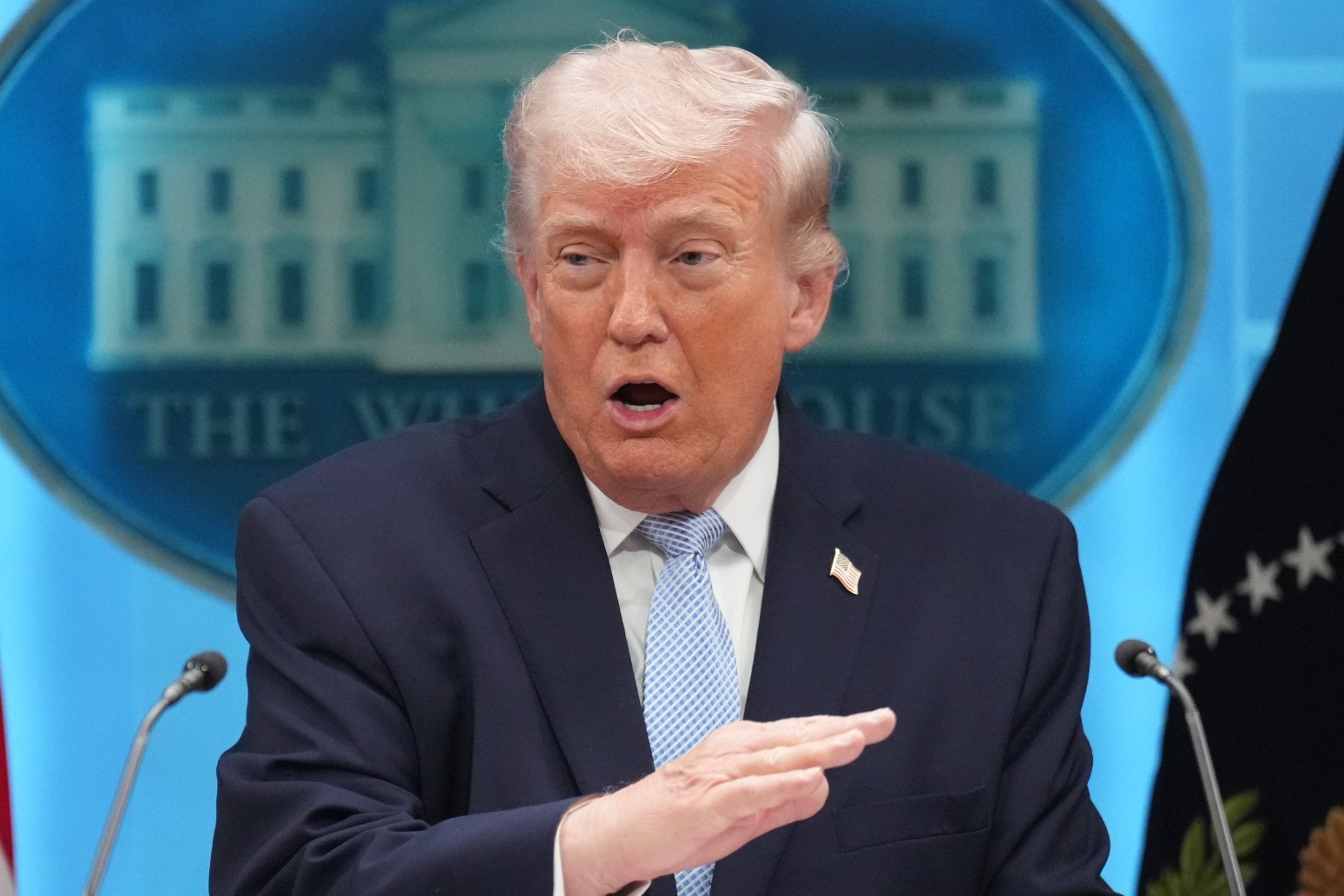
Trump agrees to halt bombing of Iran for two weeks subject to strait reopening
Donald Trump has agreed to a provisional two-week ceasefire in the Iran war after pulling back at the last-minute from his apocalyptic warning that “a whole civilisation will die” unless Tehran met his demands.
Less than two hours before his deadline passed for Iran to agree a deal, the US president said he was suspending his threat to widen the military offensive to power plants and bridges subject to the reopening of the critical Strait of Hormuz waterway.
He said Tehran proposed a 10-point plan that provided “a workable basis on which to negotiate”.
The move followed a request by Pakistan, which has been acting as a mediator in the conflict between the warring sides.
The Iranian regime said it had accepted a temporary truce but warned that its “hands remain upon the trigger”, while a White House official said Israel had also accepted the terms of the ceasefire agreement.
Israeli Prime Minister Benjamin Netanyahu said Israel backed Mr Trump’s suspension of strikes against Iran, but said any deal does not cover fighting against Hezbollah in Lebanon.
Pakistan Prime Minister Shehbaz Sharif said he had invited Iranian and US officials to Islamabad for talks on Friday.
The US president had given Tehran until 1am on Wednesday UK time to end its chokehold on the strait or face annihilation.
Writing on his Truth Social platform, Mr Trump said: “Based on conversations with Prime Minister Shehbaz Sharif and Field Marshal Asim Munir, of Pakistan, and wherein they requested that I hold off the destructive force being sent tonight to Iran, and subject to the Islamic Republic of Iran agreeing to the COMPLETE, IMMEDIATE, and SAFE OPENING of the Strait of Hormuz, I agree to suspend the bombing and attack of Iran for a period of two weeks.
“This will be a double sided CEASEFIRE! The reason for doing so is that we have already met and exceeded all Military objectives, and are very far along with a definitive Agreement concerning Longterm PEACE with Iran, and PEACE in the Middle East.”
He added: “We received a 10 point proposal from Iran, and believe it is a workable basis on which to negotiate.
“Almost all of the various points of past contention have been agreed to between the United States and Iran, but a two week period will allow the Agreement to be finalized and consummated.
“On behalf of the United States of America, as President, and also representing the Countries of the Middle East, it is an Honor to have this Longterm problem close to resolution. Thank you for your attention to this matter! President DONALD J. TRUMP”
In a later post, Mr Trump heralded “A big day for World Peace!” and predicted “the Golden Age of the Middle East” with the US helping build traffic in the Strait of Hormuz.
He wrote: “Iran wants it to happen, they’ve had enough! Likewise, so has everyone else!
“There will be lots of positive action! Big money will be made. Iran can start the reconstruction process.”
Iran’s Supreme National Security Council said it would negotiate with the US in Pakistan’s capital, Islamabad, starting on Friday.
But while accepting a ceasefire, it said in a statement: “It is emphasised that this does not signify the termination of the war.
“Our hands remain upon the trigger, and should the slightest error be committed by the enemy, it shall be met with full force.”
Iran’s foreign minister Abbas Araghchi also said ships would be allowed to pass through the strait over the next two weeks in “coordination” with the country’s military.
He said in a statement: “For a period of two weeks, safe passage through the Strait of Hormuz will be possible via coordination with Iran’s armed forces and with due consideration of technical limitations.”
Prior to the conflict, there were no restrictions and it was not clear if Iran would continue to seek to charge ships as it had been doing during the war.
On its 10-point plan for the future, Iran also said the strait would be subject to “regulated passage… under the coordination of the armed forces of Iran”.
In doing so, it would be “conferring upon Iran a unique economic and geopolitical standing”.
This would appear to be at direct odds with Mr Trump’s demand for the shipping route to be fully open to vessels and flags potential future difficulties to overcome.
In the face of ongoing military strikes by the US and Israel, Iran has tightened its grip on the critical shipping route, sending global oil and gas prices skyrocketing and causing global economic uncertainty.
Earlier, ahead of the announced ceasefire, Mr Trump said: “A whole civilisation will die tonight, never to be brought back again.
“I don’t want that to happen, but it probably will.”
Among those to criticise his ominous threat was Pope Leo XIV, who branded it “truly unacceptable”.
Separately, the US State Department said secretary of state Marco Rubio and Ms Cooper had spoken “about the Iranian regime’s ongoing attacks across the Middle East and the critical importance of restoring freedom of navigation in the Strait of Hormuz”.
A spokesman added: “The secretary and Foreign Secretary agreed on the need for international efforts to ensure shipping can move freely and energy supplies can reach global markets.”
On Tuesday, the UK chaired a meeting of military planners from a coalition of more than 30 nations examining long-term measures to make the shipping route safe and accessible once hostilities have ended.
Published: by Radio NewsHub