
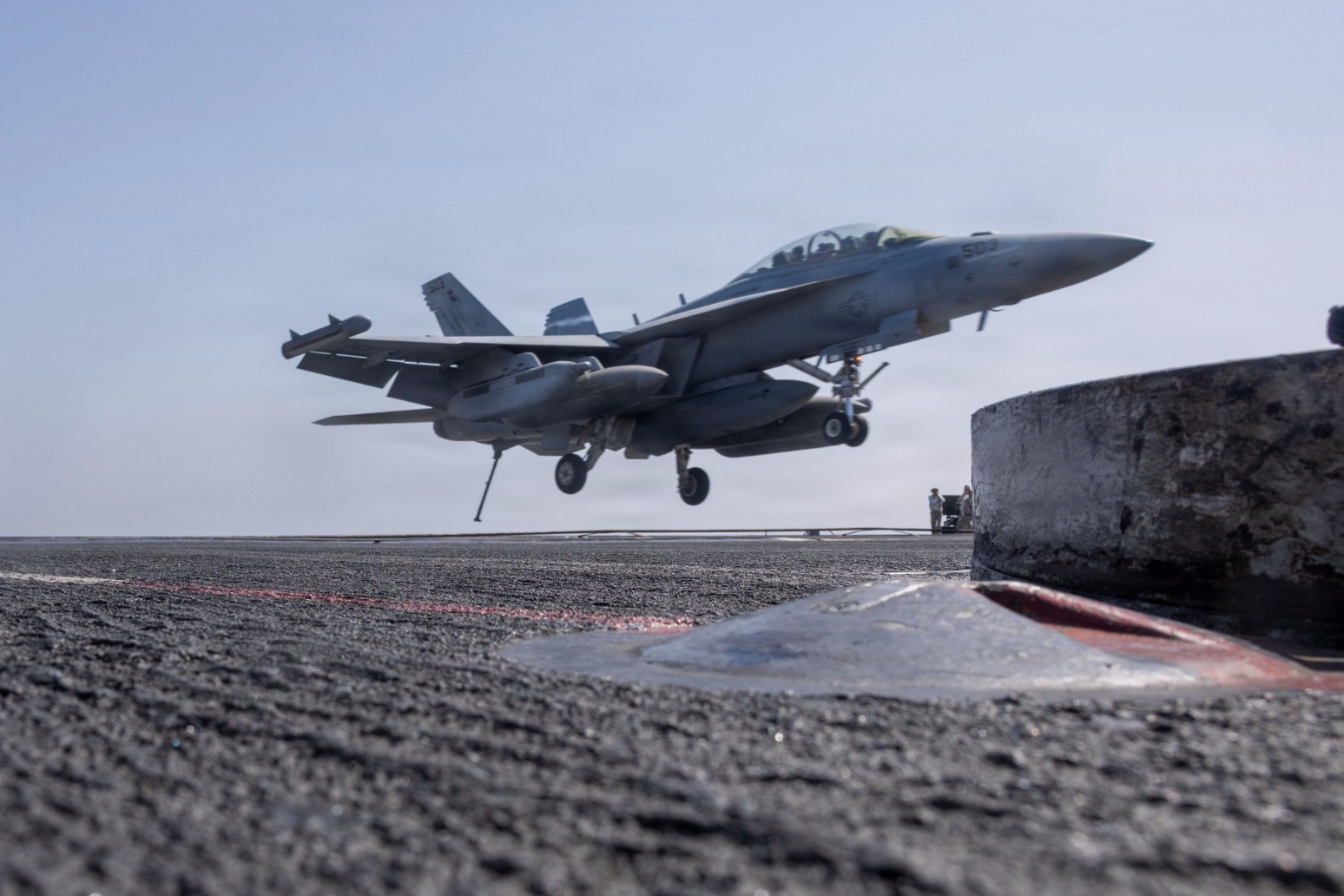
Three US troops killed in military operation against Iran
Three American service members have been killed and five have been seriously injured in military operations targeting Iran, the US military has said.
They are the first reported American casualties since the US and Israel launched a surprise attack on Iran on Saturday.
US Central Command said on X on Sunday that several other service personnel “sustained minor shrapnel injuries and concussions and are in the process of being returned to duty”.
The post said major combat operations will continue. It did not provide further information about the casualties and described the situation as “fluid”.
It came after Iran vowed revenge for the killing of its supreme leader and traded strikes with Israel as part of a widening war prompted by the surprise attack launched on Saturday.
Blasts in Tehran sent a huge plume of smoke into the sky on Sunday in an area where there are government buildings.
Iranian authorities say more than 200 people have been killed since the start of the US and Israeli strikes that killed Ayatollah Ali Khamenei and other senior leaders.
Iran fired missiles at an ever-widening list of targets in Israel and Gulf Arab states in retaliation, while Israel pledged “non-stop” strikes against Iran’s leaders and military.
In Tehran, there was little sign that Iranians had heeded US President Donald Trump’s call to overthrow their government. The streets were largely deserted as people sheltered during heavy airstrikes, witnesses told The Associated Press. The paramilitary Basij, which has played a central role in crushing protests, has set up checkpoints across the city, they said.
In southern Iran, at least 165 people were killed when a girls’ school was struck, and dozens more were wounded, the state-run IRNA news agency reported.
The Israeli military said it was not aware of strikes in the area. The US military said it was looking into the reports.
The US military said three service members were killed and five others seriously wounded, without providing further details. It said several others suffered minor injuries and concussions.
In Israel, loud explosions caused by missile impacts or interceptions could be heard in Tel Aviv. Israel’s rescue services said nine people were killed and 28 wounded in a strike that hit a synagogue in the central town of Beit Shemesh, bringing the overall death toll in the country to 11. Eleven people were still missing after the strike, police said, as rescue crews combed the rubble.
Meanwhile, the US military said B-2 stealth bombers had struck Iran’s ballistic missile facilities with 2,000-pound bombs.
Ballistic missiles have been one of the concerns Mr Trump had raised in the lead-up to the attacks.
The US president also said the military had sunk nine Iranian warships.
Meanwhile, Iran’s President Masoud Pezeshkian said in a pre-recorded message aired on state television that a leadership council had begun its work, and foreign minister Abbas Araghchi said a new supreme leader would be chosen in “one or two days”.
A senior White House official said on Sunday that “new potential leadership” in Iran had suggested they were open for talks with the United States.
The strikes and counter-attacks underscore how the killing of Mr Khamenei, and Mr Trump’s calls for the overthrow of the decades-old Islamic Republic, carry the potential for a prolonged conflict that could envelop the Middle East.
It is the second time in eight months the Trump administration has joined Israel in using military force against Iran, and is a startling show of military might for an American president who swept into office on an “America First” platform and vowed to keep out of “forever wars”.
In a 12-day war in June, Israeli and American strikes greatly weakened Iran’s air defences, military leadership and nuclear programme. But the killing of Mr Khamenei and several top security officials creates a leadership vacuum, increasing the risk of regional instability.
The CIA had been tracking the movements of senior Iranian leaders, including Mr Khamenei, for months, according to a person familiar with the operation.
The intelligence was shared with Israeli officials, and the timing of the strikes was adjusted in part because of that information, the source said.
As word spread of Mr Khamenei’s death, some people in Tehran could be seen cheering from rooftops, witnesses said. Others mourned, as a black flag was raised over the Imam Reza shrine in Mashhad.
After confirming the death of Mr Khamenei early on Sunday, Iran’s parliamentary speaker, Mohammad Bagher Qalibaf, said in a televised address: “You have crossed our red line and must pay the price.
“We will deliver such devastating blows that you yourselves will be driven to beg.”
Meanwhile, Mr Araghchi said that despite the attacks on Iran, “nothing has changed in our… military capability”.
He told ABC’s This Week in the US that in only a few hours after his country was struck, Tehran had retaliated against Israeli targets and American bases “and we have continued to do so. So, our military is in place. They are capable enough to defend our country”.
Asked whether a diplomatic deal with the Trump administration was still possible, he said: “We negotiated with the United States twice in the past 12 months. And in both cases, they attacked us in the middle of negotiation. And that has become a very bitter experience for us.”
He said “a deal was at our reach, and we left Geneva happily with the understanding that we can reach a deal next time we meet”.
Mr Trump warned any retaliation to these recent attacks would only lead to further escalation.
Meanwhile, Reza Pahlavi, the exiled son of Iran’s last shah overthrown during the 1979 Islamic Revolution, claims he is taking charge of the transition to a new government.
Speaking to Fox News Channel’s Sunday Morning Futures in the US, he said: “This is time now for a very strong, stable transition. I am leading this transition. I have the support of millions of Iranian people. I have the people inside the country that are joining… the military will side with us. We have a plan of action and a transition plan.”
He said that the process would lead ultimately “to a democratic outcome so the Iranian people get to choose their future government and system”.
As Iran targeted the wider Gulf area, the United Arab Emirates said on Sunday three people had been killed so far in Iranian attacks on the country.
The defence ministry said Iran had launched 165 ballistic missiles targeting the country, of which 152 were destroyed. Thirteen fell into the sea, it added.
Iran launched 541 bomb-carrying drones at the UAE, of which 506 were destroyed. Another 35 struck the country, killing three people from Pakistan, Nepal and Bangladesh, while 58 others were wounded.
In a sign that the attack could spread instability throughout the region, at least 10 people were killed in clashes with police as hundreds of people stormed the US consulate in Pakistan’s port city of Karachi on Sunday, smashing windows.
After the initial strikes on Saturday, Iran immediately launched missiles and drones towards Israel and US military installations in Bahrain, Kuwait and Qatar.
Flights across the Middle East were disrupted, and air defence fire thudded over Dubai, the United Arab Emirates’ commercial capital, with explosions continuing on Sunday.Shrapnel from Iranian attacks on the Emirates’ capital of Abu Dhabi killed two people, state media said, and debris from aerial interceptions caused fires at the city’s main port and on the facade of Dubai’s iconic Burj Al Arab hotel.
Attacks also extended into Oman – Iran’s long-time interlocutor with the West that had not been drawn into the fray previously.
Saudi Arabia condemned Iran’s attacks on its capital, Riyadh, and eastern region, saying it had successfully intercepted them. The kingdom noted that it had not allowed its airspace or territory to be used to target Iran.
Jordan said it “dealt with” 49 drones and ballistic missiles. Kuwait, Bahrain and Qatar also said they had intercepted projectiles on Sunday morning.
Published: by Radio NewsHub