
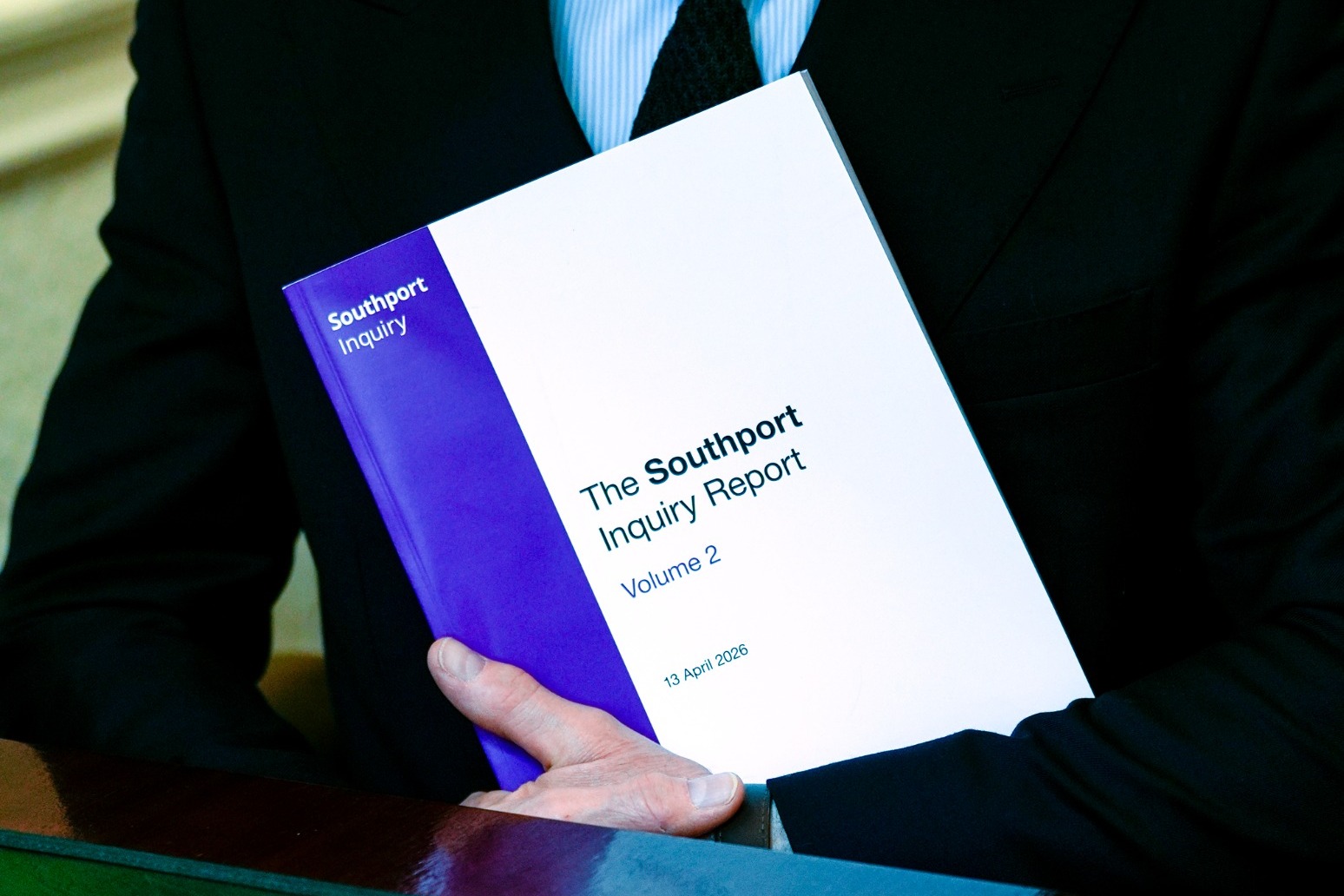
Southport attack ‘could and should have been prevented’, inquiry finds
Southport killer Axel Rudakubana had “clearly revealed” he was an extreme danger and his attack on a children’s dance class “could and should have been prevented”, a public inquiry has found.
The teenager, who was jailed for a minimum of 52 years, could have been stopped if his parents had “done what they morally ought to have done”, or if appropriate arrangements had been put in place by agencies to address his risk, chairman of the Southport Inquiry Sir Adrian Fulford said in his report, published on Monday. Alice da Silva Aguiar, nine, Bebe King, six, and Elsie Dot Stancombe, seven, were murdered when Rudakubana entered the Taylor Swift-themed dance workshop in The Hart Space, armed with a knife, on July 29 2024. The killer, then 17, also attempted to murder eight other children, who cannot be named for legal reasons, as well as class instructor Leanne Lucas and businessman John Hayes. In his report, comprised of two volumes with a total of 763 pages and setting out 67 recommendations, Sir Adrian said there was a “fundamental failure” by any organisation, or multi-agency arrangement, to take ownership of the risk Rudakubana posed. In a statement delivered at Liverpool Town Hall as the report was published, Sir Adrian said: “I have no doubt that if appropriate procedures had been in place and if sensible steps had been taken by the agencies and AR’s parents, this dreadful event would not have happened. “It could have been and it should have been prevented.” Sir Adrian said the failure, at an organisational and individual level, to “stand up and accept responsibility” for managing the risk the killer posed was a “frankly depressing – and therefore urgent – matter requiring Government attention”. He said: “Far too often, AR’s ‘case’ was passed from one public sector agency to another in an inappropriate merry-go-round of referrals, assessments, case-closures and ‘hand-offs’.” Solicitor Nicola Ryan-Donnelly from Fletchers, representing 22 children injured in the attack, said the report made for “disturbing reading”. She said: “We ask that where recommendations have been made, those individuals and agencies to which they are addressed, take action, now. Not tomorrow. This must not happen again.” Sir Adrian said the teenager’s parents, Alphonse Rudakubana and Laetitia Muzayire, had “created significant obstructions” to engagement with him by various agencies and failed to stand up to his behaviour and set boundaries, as well as failing to report a clear escalation in his risk. He said: “If AR’s parents had done what they morally ought to have done, AR would not have been at liberty to conduct the attack and it would not therefore have occurred.” But, he said it should have been “obvious” to those in a position to act that Rudakubana was not being “effectively parented”. Both Rudakubana’s parents, who moved to the UK from Rwanda, gave evidence to the inquiry from remote locations. His mother told the hearing: “There are many things that Alphonse and I wish we had done differently, anything that might have prevented the horrific event of July 29 2024. “(For) our failure, we are profoundly sorry.” Sir Adrian said Rudakubana had “clearly revealed the extreme danger that he presented to others” more than four years before his attack, when he went his former school, the Range High School in Formby, armed with a kitchen knife and a hockey stick and attacked a student. The inquiry chairman said the incident in December 2019, for which the teenager received a 10-month referral order, was a “watershed event” and should have led agencies to conclude he posed a “high risk of harm to others”. The inquiry heard between 2019 and 2024, Rudakubana was referred to anti-terror programme Prevent three times, but the referrals were closed. He purchased a number of weapons, including three machetes, online as well as ingredients he used to make the poison ricin. Sir Adrian said as time passed, interaction between Rudakubana and organisations became “at best, something of a token”. He said: “They were unaware of his continuing chilling internet preoccupations and his accumulation of lethal weapons, as well as the ingredients for a lethal poison.” The chairman recommended the second phase of the inquiry should consider a single agency or structure to be appointed to monitor interventions for children presenting a high risk of serious harm. Sir Adrian said “degrading, violent and misogynistic material” viewed online by Rudakubana fed his “already unhealthy fascination with violence”. Downloads including an Al-Qaeda training manual, a history of Nazi Germany and documents on wars in Rwanda, Sri Lanka, Somalia and South Sudan, were discovered on tablets belonging to Rudakubana after his attack. The inquiry chairman said the lack of exploration of Rudakubana’s “online life” was a “significant failure” which prevented agencies from identifying and addressing his risk. He recommended that the second phase of the inquiry should consider abilities to restrict or monitor access to the internet of children if they pose a risk to others. Sir Adrian also said agencies failed to recognise that Rudakubana’s diagnosis of autism spectrum disorder “significantly increased the risk that he posed” and there was a “repeated tendency” to excuse his behaviour on the basis of his autism.
Published: by Radio NewsHub