
Single-sex spaces code comes in force more than year after Supreme Court ruling
Guidance on use of toilets and changing rooms as single-sex spaces comes into force on Wednesday, almost a year-and-a-half after the landmark Supreme Court ruling on biological sex.
Described as giving “up-to-date examples of how the Equality Act applies to everyday situations”, it will be something that can be relied on in court if there are legal challenges – which Equalities Minister Bridget Phillipson has previously suggested is expected “because this is a very contested space”.
While Britain’s equalities regulator has stressed that its updated code of practice does not make new law or create new legal obligations, it provides services such as cafes and leisure centres with legally accurate, impartial and up-to-date guidance on existing law.
The April 2025 Supreme Court ruling was hailed by campaigners as a victory confirming “women are women and men are men” – although others called it “incredibly worrying for the trans community”.
When the code, which covers England, Scotland and Wales, was published in draft form in May – having been updated for the first time in more than a decade – Equality and Human Rights Commission (EHRC) chairwoman Mary-Ann Stephenson described it as a “major milestone”.
The code confirmed a service must be used on the basis of biological sex in order for it to be classed as single-sex under the Equality Act, as per the Supreme Court ruling.
This means single-sex toilets, changing rooms, hospital wards and refuges must be used based on a person’s birth sex, not the gender with which they identify.
It has been suggested unisex services such as self-contained lockable cubicles could ensure provision of toilets and changing rooms for all, with the code noting it would be “very unlikely to be proportionate to put a trans person in a position where there is no service that they are allowed to use”.
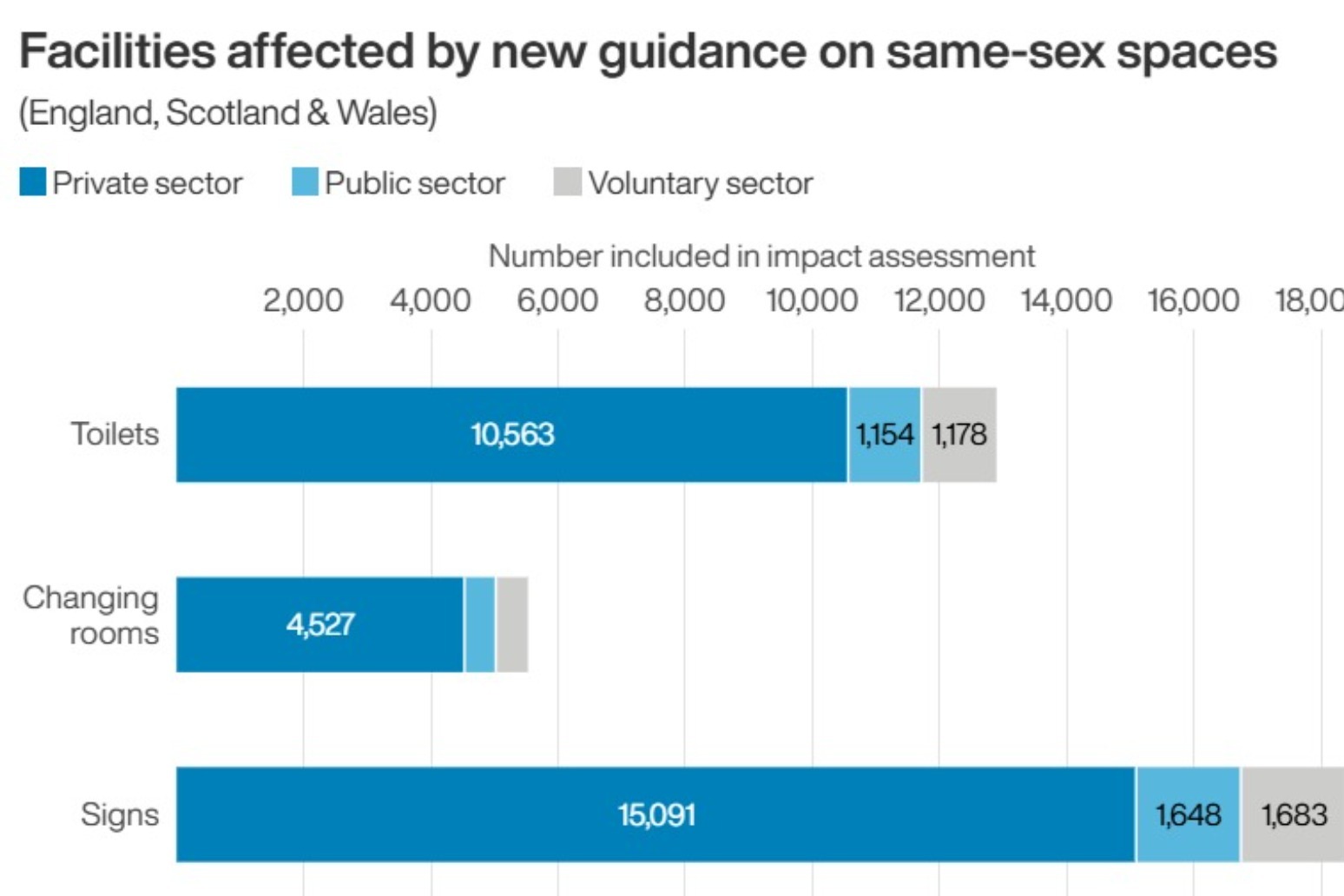
Press Association analysis suggests nearly 13,000 toilets and more than 5,000 changing rooms could have to be revamped at gyms, hospitals and leisure centres across Britain at a cost of millions as a result of the guidance.
At least 18,000 signs might also need to be changed, according to figures obtained by PA through a Freedom of Information request to the EHRC earlier this year.
Public-sector bodies, such as local councils, are estimated to face unadjusted costs for cleaning the new-look facilities totalling £20.6 million, together with £14.2 million per year for building work – though these sums could rise even higher.
In the face of previous criticism for the delay in publishing the code, the Government had repeatedly insisted it was “taking the time to get this right” and has suggested “many businesses will already be largely compliant with the code so there will be no cost at all”.
The updated guidance affects service providers such as restaurants, leisure centres and hairdressers; public functions such as council services; and associations such as local sports clubs with at least 25 members.
Appearing before the Women and Equalities committee in June, Ms Phillipson – who has since lost her previous post as Education Secretary under Andy Burnham’s new premiership but kept her equalities role – said it is her expectation that “because this is a very contested space, there will continue to be further debate, challenge, scrutiny, legal challenge”.
She told MPs at the time: “That would be the case, whatever the draft code said.”
Asked if she was worried about the financial and more general impact of legal challenges and “lawfare” on organisations, she said while she understands some, particularly smaller ones without access to big budgets, might find this area “difficult”, she believes the code “provides for what is needed across the protected characteristics”.
Former home secretary Suella Braverman, who is now Reform UK’s equalities spokeswoman, said the Government had been “dragged kicking and screaming into adopting simple common sense and protecting women’s-only spaces”.
She added: “The Government and EHRC now have no excuse in not enforcing and upholding the law.
“That means getting tough with civil servants and public sector bodies who continue to buy into nonsensical woke definitions of gender and threaten the rights and privacy of British women and girls.”
Published: by Radio NewsHub