
Divers revitalise site of wrecked Georgian warship
Volunteer divers have revitalised a dive trail to the site of a Georgian warship.
HMS Colossus was a 74-gun warship built in Kent in 1787 which sank off the Isles of Scilly in 1798.
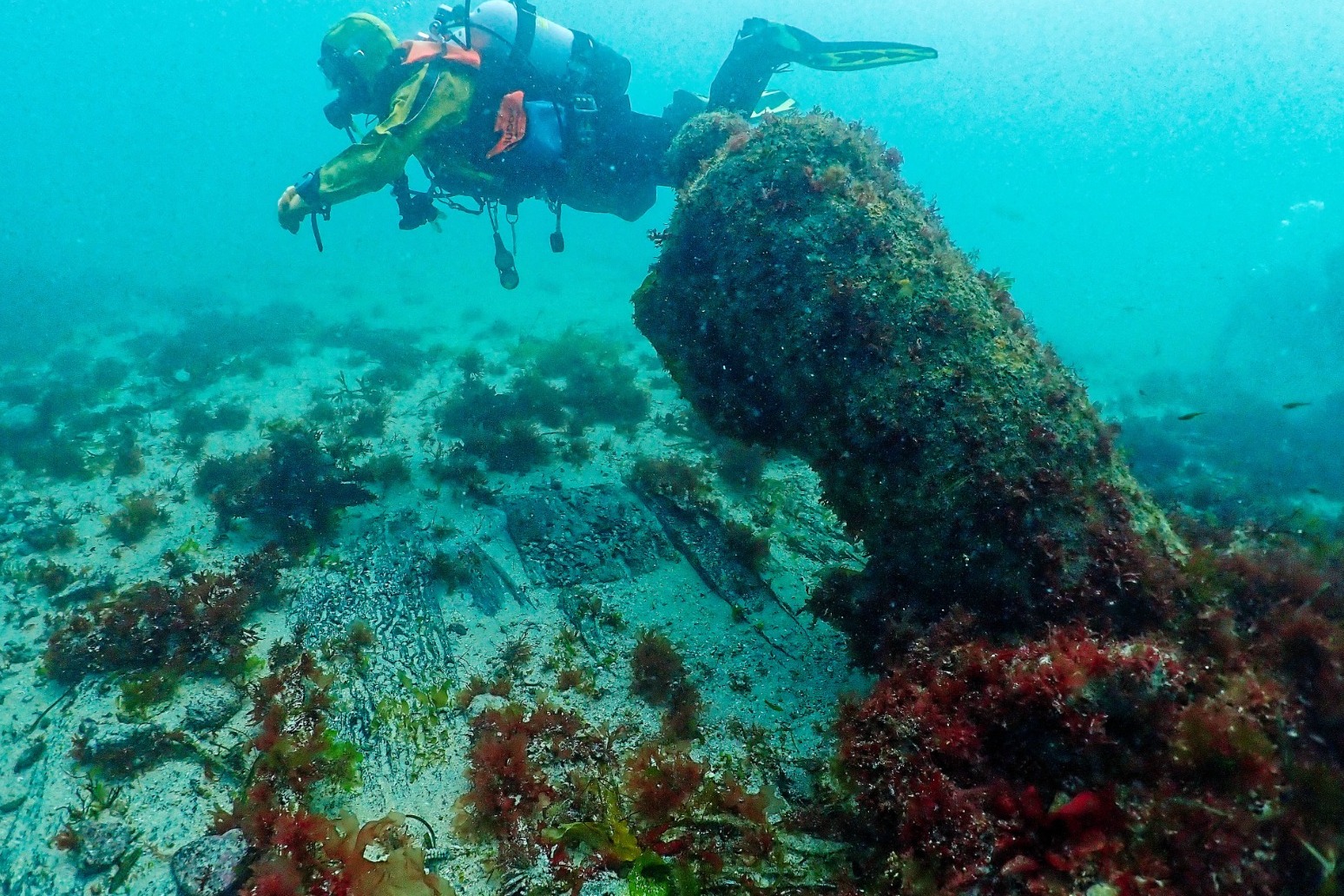
Historic England commissioned volunteer divers to refurbish the trail, helping make the site more accessible to both visitors and virtual audiences.
The team cleared marine growth from archaeological features, including cannons, rudder fittings and hull timbers and installed new dive stations.
They also assessed the condition of the wreck site and produced new photography and video footage to showcase the wreck and its rich marine environment.
During its 11-year service the warship saw action at Toulon, Groix, Cape St Vincent and Cadiz.
In December 1798, while sheltering from a storm off the Isles of Scilly, the ship’s anchor cable gave way and it was driven onto shallow ground off Samson, the largest uninhabited island off the southwestern tip of the Cornish peninsula.
All but one of the 595 people on board were rescued.
HMS Colossus later broke apart, scattering its remains across the seabed.
The ship is also known for carrying part of 18th century British diplomat and antiquarian Sir William Hamilton’s collection of ancient Greek pottery.
Some 30,000 pottery fragments recovered from the wreck site are held by the British Museum.
The resting place of HMS Colossus is one of 57 Protected Wreck Sites and means only licenced divers can visit.
The refurbished trail features two circular routes taking in the major features of the wreck with numbered seabed stations and an improved waterproof guide.
For those unable to visit in person, an interactive virtual tour mirrors the underwater trail, combining detailed 3D models, dive footage and photography to bring HMS Colossus to life.
Published: by Radio NewsHub