
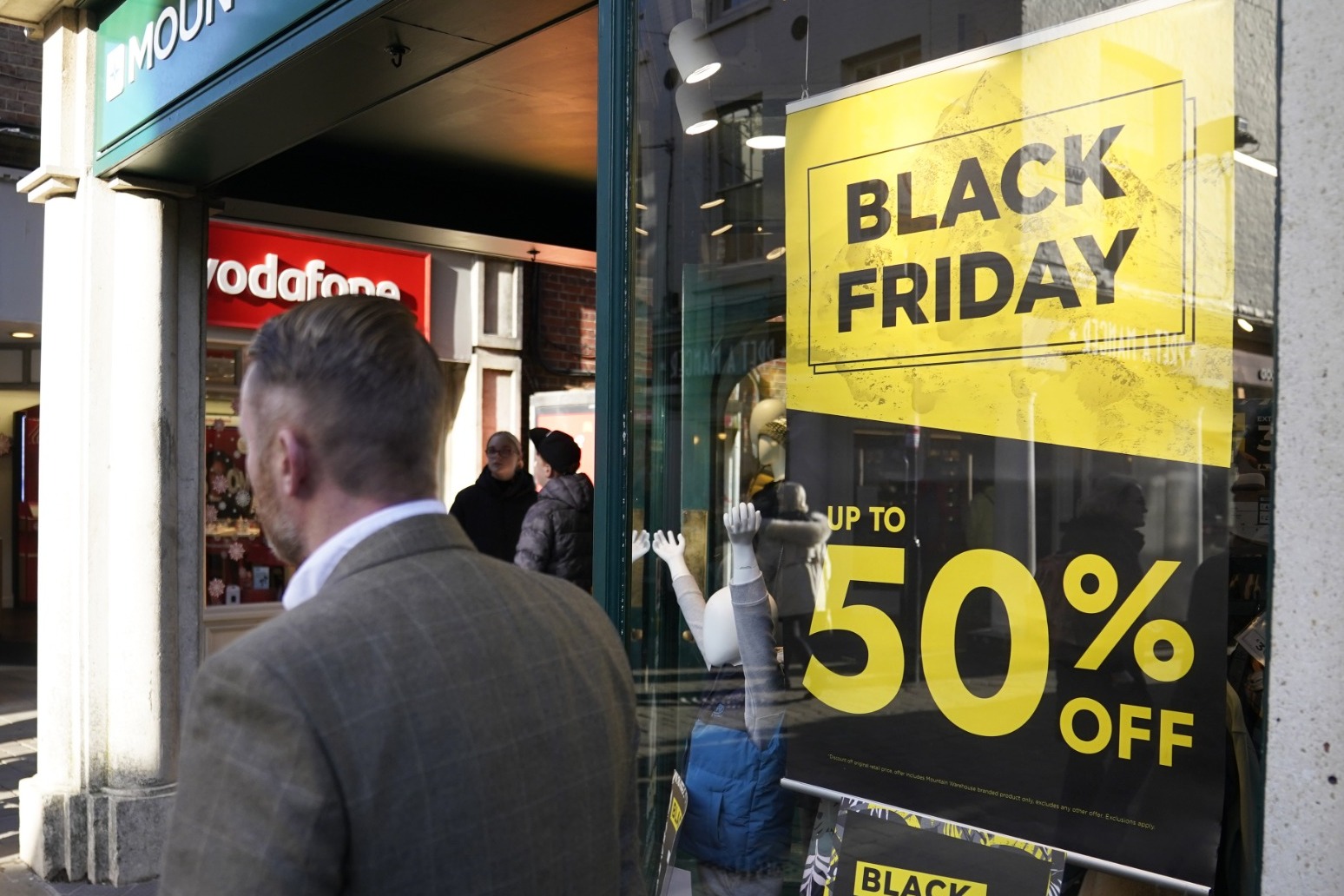
Pre-Budget shopper ‘jitters’ dampen Black Friday sales
Pre-Budget “jitters” among shoppers dampened a much-needed Black Friday boost for retailers, figures show.
Total retail sales across the UK increased by 1.4% year on year in November – the weakest growth in six months despite elevated inflation, according to the British Retail Consortium (BRC) and KPMG.
Food sales were up 3%, but even this was below the 12-month average growth of 3.6%.
Sales of products other than food increased by just 0.1% year on year, again below the 12-month average of 1.6%.
Online non-food sales increased by 0.5% against a decline of 10.3% last November, and below the average across the year of 2.5%.
Homeware and upholstery sold well as households prepared to host over the festive season, while fashion sales lagged as the mild first half of November dampened demand for winterwear.
BRC chief executive Helen Dickinson said: “Pre-Budget jitters among shoppers meant the month of Black Friday did not deliver as strongly as retailers had hoped or the economy needed.
“It has been a difficult year as retailers grappled with ever-rising cost pressures.
“Looking ahead to 2026, it is time public policy started prioritising measures to revive consumer confidence and keep costs of doing business down so retailers can focus on growth strategies to maximise their contribution to economic recovery.”
Linda Ellett, UK head of consumer, retail and leisure markets at KPMG, said: “November delivered some growth in retail sales, but many retailers will be disappointed that Black Friday period promotions failed to deliver the bigger boost that they were hoping for.
“While the likes of computing and household appliances outperformed Black Friday week last year, total non-food sales growth across all categories was minimal overall.
“Rising household costs and nervousness about the economy continue to impact discretionary buying.
“But retailers will be hoping that Budget clarity has now provided more certainty for consumers about their ability to spend in the months ahead.”
Separate figures from Barclays show consumer card spending fell 1.1% year-on-year in November – the greatest fall recorded since February 2021.
The bank said overall retail spending dipped 1.1%, but retailers still enjoyed their busiest day of the year so far on Black Friday, with transaction volumes up 62.5% in comparison to the average day in 2025.
Travel agents also enjoyed a Black Friday boost, up 10.7%, while streaming and subscriptions increased 3.5% thanks to hit shows such as Stranger Things and Pluribus.
However pub spending slowed by 1.5%, with 42% of those aged 18 to 34 opting for alcohol-free drinks and 40% for alcohol-free activities.
Consumer and economic confidence remained at 22% in November, on a par with October, while UK adults’ confidence in their household finances improved marginally from 63% to 64% – although this remains below 2025’s 70% average.
Jack Meaning, chief UK economist at Barclays, said: “Even with a boost from Black Friday, consumer spending remained muted as we moved through the final quarter of the year.
“2025 has been defined by this economic deceleration.
“The question remains as to whether easing interest rates and falling inflation can offset this trend and spur a rebound in consumer spending, or whether tightening fiscal policy and continued uncertainty will see the malaise continue in 2026.”
Published: by Radio NewsHub